One operational thread across scheduling, materials, execution, quality, maintenance and dispatch: paperless, SAP/LIMS/PLC-connected, and proven in production since 2007.
The most significant operational losses in batch manufacturing do not occur within a single department. They occur in the transitions between them, in handoffs, waiting, mismatched data, manual coordination, and undocumented workarounds.
Every department runs well on its own. The batch still waits: between the warehouse and the line, between production and quality, between the plant and the ERP.
Each system holds one slice: the ERP knows the order, SCADA knows the signals, paper knows the rest. No system holds the operational thread.
Wait time and spreadsheets. Partials and loss-and-gain materials returned from production. Investigations that take weeks. Release that takes days.
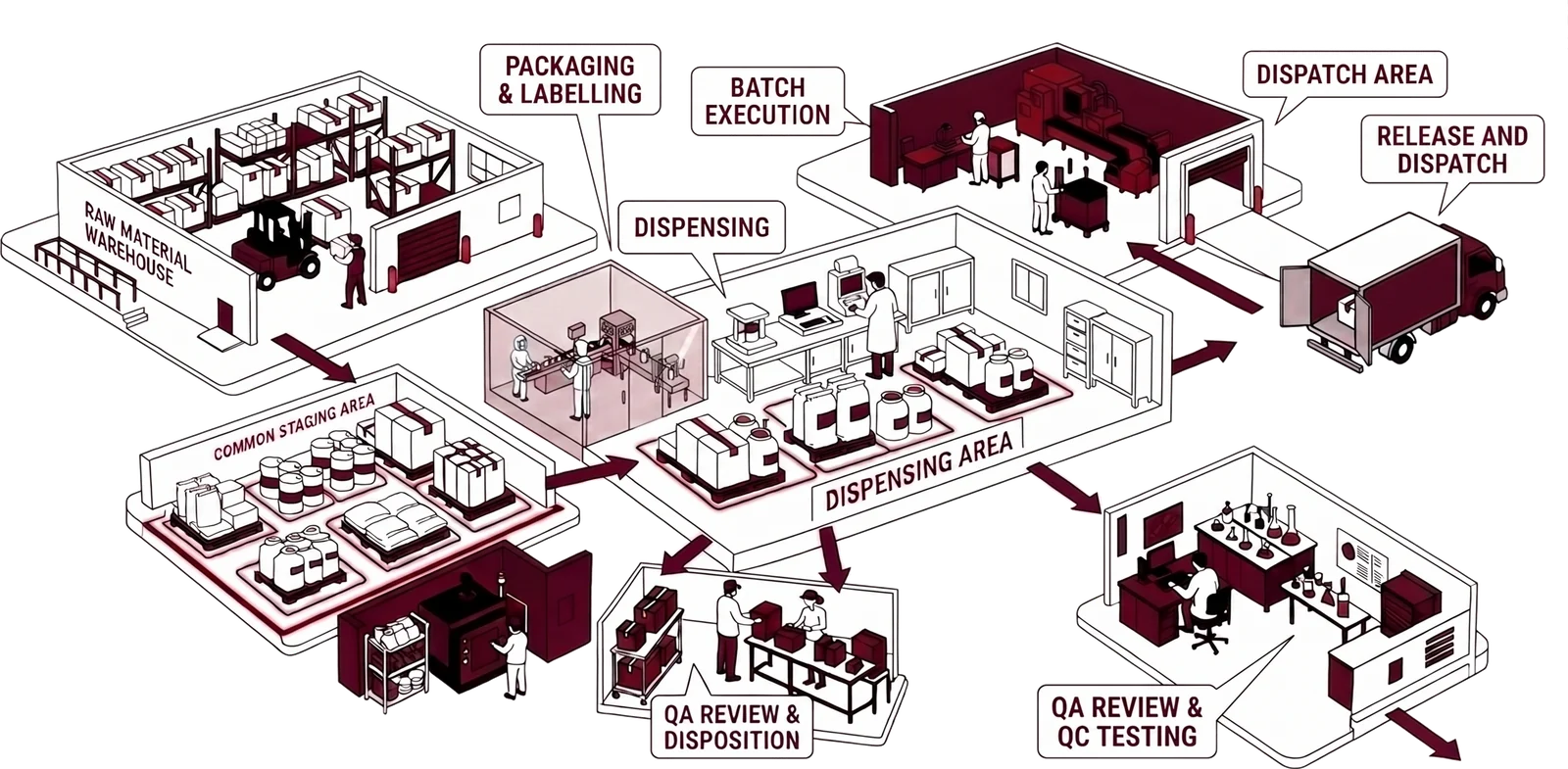
ERP standardises the enterprise. MOM orchestrates plant operations. AI optimises outcomes. Vegam SFS orchestrates batch manufacturing beyond MES: production execution connected with materials, quality, equipment and plant-wide workflows on one thread.
Follow a batch through the platform. Each step is a working screen: what it replaces, what it enforces, where the data goes, and what you can prove afterwards.
Production orders sync from SAP, or upload manually via Excel, and planners sequence them by drag-and-drop with real-time visibility into resource availability. The plan reflects the plant, not a spreadsheet.
Planning spreadsheets and the Monday scheduling meeting.
Material coverage and resource availability checked before commit.
Orders in from SAP/ERP; the committed schedule to the shop floor.
Why every batch ran when it did: constraints on record.
From supplier pre-registration to quality-approved stock: truck registration with live status counts, safety checklists, weighbridge in/out weights, CoA verification, ERP goods receipt and status-controlled bins.
Paper gate logs and quantities that surface wrong weeks later.
PO, material, batch and quantity verified at the dock; CoA status gates release.
PO details in from SAP; GR and every movement posted back in real time.
Who received what, from whom, at what weight, per delivery.
The preweight monitor guides weighing and kitting to recipe: full-bag or preweigh kits, per line, with the tolerance limit enforced at the scale and the material’s PPE requirements and H-code hazard statements displayed at pick.
Manual weigh sheets, paper kits, and safety knowledge held in heads.
Right material, lot, bin and quantity: within tolerance; cut-open bags and returns tracked.
Scale readings captured directly; issues and returns posted to SAP in real time.
Exactly what went into the kit, weighed by whom: genealogy starts here.
The batch runs phase by phase against the approved SOP version: cycle times, CCP limits and sign-offs enforced at the step, with PLC, DCS and IoT parameters captured automatically in context.
Paper batch tickets and end-of-shift reconstruction.
Phase order, CCP limits, photo evidence and role-based sign-offs.
Temperature, pressure, pH, viscosity, flow in from PLC/DCS; the EBR builds as it runs.
The complete as-run record: who, what, when, within what limits.
QC samples run through the batch, not after it: results land against specification per phase, the E-COA assembles itself, and LIMS exchanges test requests, sample IDs, results and approvals bi-directionally.
Quality on spreadsheets and line-by-line record review.
Checkpoints that hold the batch until results pass or are dispositioned.
Bi-directional LIMS; results posted to SAP QMS: inspection lots stay in sync.
Every test, against every spec, with the release decision on record.
Outbound runs through nine governed states, from crossdock to loading complete, with batch verification at pick, serialized-number scanning, GHS and customer-standard labels, and safety guidance at loading.
Dispatch documents assembled by hand at the door.
Batch verification, serialized scans and label compliance before loading.
Delivery orders in from the ERP; confirmations and documents back from the record.
What shipped, in which pack, to whom, with which labels.
OEE with its availability, performance and quality indices, plus TEEP and bottleneck detection across machine groups. Downtime is reason-coded by operators as it happens, not reconstructed at month end.
Month-end downtime reconstruction and OEE spreadsheets.
Reason-coded stops: planned and unplanned, captured at source.
Machine signals and counters in; OEE, TEEP and loss analysis out to dashboards and BI.
Where the time went, per line, machine and reason, and where the bottleneck is.
Every action: kitting, phase starts, mix confirmations, samples, downtime: lands in the process log with its SAP reference, building batch genealogy across materials, machines, operators and tests as the work happens.
Traceability investigations that take days across binders and systems.
Genealogy captured as work happens, not assembled afterwards.
Time-stamped logs with SAP queue references; feeds dashboards, historians and AI Intime.
Full forward and backward trace, in minutes, for any batch or lot.
The buyer’s mental model is not a module list: it is their own plant. Pick a stage to see what happens, where it breaks down and how vSFS runs it. The module that owns that stage lights up on the map below.
Platform capability map
Running across every stage
Planning, sequencing, resource allocation and manufacturing coordination.
Maintenance scheduling, equipment health, downtime analysis and condition monitoring.
ERP, DCS/PLC, SCADA, SAP environments and industrial IoT systems.
vSFS is the operations layer: enterprise systems above it, automation below it, one governed thread through it. No system of record is replaced.
What moves: production orders · material movements · inventory · batch records · goods receipt and issue · master data · production confirmations. The return leg is the point, your system of record stays accurate.
Vegam SFS supports an SAP clean-core strategy by managing plant-specific workflows, execution rules, recipes, SOPs and exceptions within a governed manufacturing operations layer. Corporate defines the standards. Plants configure approved variations. Vegam SFS governs and connects both.
The record is not assembled for the audit: it is created by the work itself. vSFS supports compliance programs including GMP and 21 CFR Part 11 with electronic batch records, secure time-stamped audit trails, and role-based sign-offs and approvals.
Who did what, when, to which record, captured immutably as work happens.
Role-based approvals and sign-offs captured at the step that requires them: versioned, time-stamped, attributable.
Reviewers see the flagged deviations, not every line of every record.
Batch to lot to equipment to operator to test: forward and backward.
100% paperless, recipe-driven production: digitized batch and dispatch operations starting in India and China, with ROI achieved in under 12 months.
vSFS began with a 2007 deployment at a Henkel plant in Australia, and scaled across Henkel’s 134-site adhesives network after a 10% pilot rollout.
OEE deployed across 32 production lines in 15 plants: rolled out in six months, with unified global visibility of OEE and downtime.
“Vegam has transformed our complex operations with seamless SAP integration, a user-friendly interface, and German language support, which made adoption easy and boosted our efficiency.”
WAYNE TOWELL · GROUP VP GLOBAL OPERATIONS, MBCC GROUP
“Vegam’s transparency and agile problem-solving have elevated team collaboration and operational dialogue, no matter where I am.”
DR. BJÖRN JACKISCH · PRESIDENT, HENKEL US OPERATIONS
Likelihood of benefit · % reporting
57% report improved operational efficiency — the direct effect of digitised execution, handoffs and real-time visibility.
Competitiveness (49%), customer satisfaction (42%) and profitability (32%) track behind operations: execution improvements compound into business ones.
Across every category measured, only 1% of responses report no tangible benefit at all.
Both, structurally: vSFS includes manufacturing execution (digital SOPs, batch execution, operator guidance) inside a broader manufacturing operations management platform that also orchestrates scheduling, materials, quality, maintenance and dispatch on one thread. MES digitises production; MOM orchestrates operations.
No. vSFS synchronises with the ERP: production orders and master data come in; material movements, goods receipt and issue, batch records and production confirmations go back. It supports an SAP clean-core strategy by keeping plant-specific logic in the operations layer.
Through standard industrial protocols and systems: PLC and DCS integration, SCADA, OPC UA and OPC DA, Modbus, MQTT, and plant historians: alongside LIMS and quality systems on the lab side.
Batch and process manufacturing first: chemicals, coatings and construction materials, pharma, FMCG, food and beverage, with discrete manufacturing also supported. It has been deployed across 325 plants in some 60 countries.
Corporate defines the standards: master data governance, common KPIs, harmonised controls. Plants configure approved variations: local workflows, SOPs, equipment definitions and exceptions. vSFS governs and connects both, so sites stay comparable without being forced identical.
Yes: electronic batch records assembled as the batch runs, immutable audit trails, role-based sign-offs at the step, and review by exception. vSFS supports GMP and 21 CFR Part 11 compliance programs.
vSFS creates the operational truth: the unified, high-fidelity record AI needs. On that foundation, AI Intime builds knowledge twins and governed agents for scheduling, quality and operations. AI cannot optimise a factory it does not understand; vSFS is how it understands.
A working session with your batches, your materials, your constraints, not a slide deck.