Vegam connects batch execution and operational context across the plant to help chemical manufacturers understand what makes a successful batch different, detect deviations earlier and repeat Golden Batch performance more consistently.
Reduce the cost of variability across materials, processes, equipment and quality.

Chemical manufacturing combines complex recipes, shared reactors, variable raw materials, tight quality requirements and interdependent production schedules. Vegam connects batch execution, process, material, equipment and quality data to help manufacturers understand what drives a successful batch, identify deviations early and make Golden Batch performance repeatable.
More recipes, variants and changeovers on the same set of assets.
More traceability, more electronic records, more to evidence at audit.
More production dependencies across reactors, mixers and lines.
Experienced operators retire or move, while the process knowledge that mattered stays undocumented.
More complexity means more ways to lose time, yield and capacity.
Every system in the plant is right about its own slice. None of them holds the relationship between the slices, and that is where the answers live.
Why did this batch fail?
Why did yield drop?
What changed?
What should we do?
Nothing has to break. Every additional product, changeover and manual step quietly converts productive reactor hours into coordination, cleaning and waiting.
Vegam makes the cost of complexity visible by connecting scheduling, batch execution, materials, quality, OEE and the Golden Batch on one operational record.
A deviation rarely costs only the material that was lost. It can consume reactor hours, operator time, QC capacity, energy, inventory and the production schedule.
The visible cost is rework. The hidden cost is capacity, time and schedule consumed by the problem.
Every stage carries the context required to compare the current batch with the Golden Batch, understand where it diverges and identify what changed. Click a stage to see the operational reality, and what changes when the context travels with the batch.
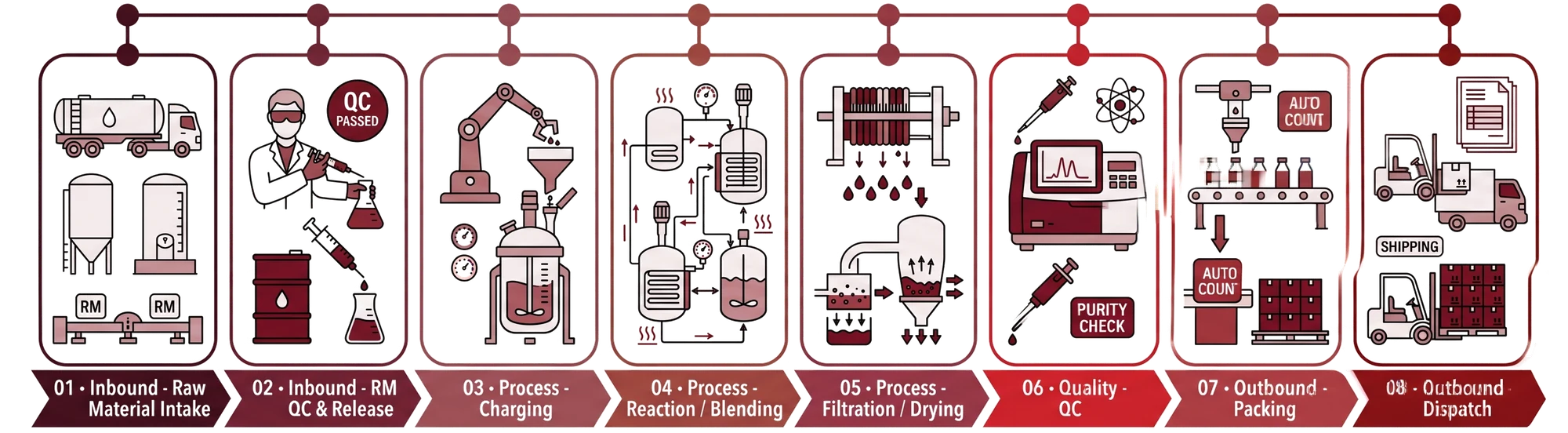
CONCURRENT · In-process control is continuous across reaction and filtration, not a single checkpoint. CIP/COP cleaning runs between batches.
Forward from a raw-material lot to every shipment it reached. Backward from a customer complaint to the reactor, the parameters and the intervention behind it. One chain, held by the operational record rather than reassembled from eight systems.
Find it · Explain it · Repeat it
Compare the batches that ran well against the ones that varied, across material lots, process parameters, timing, equipment behaviour, operator interventions and quality outcomes. What emerges is not a prediction. It is the set of conditions associated with consistently successful production.
Reaction stage, 82.4 °C against a 78.0–79.5 °C band.
Raw-material lot RM-819, which also appears in the other two low-yield batches this campaign.
−3.1 % against the Golden Batch reference for Adhesive X v4.2.
What makes your best batches different.
Current production against Golden Batch behaviour.
Where the current batch begins to diverge.
Before variability becomes a larger loss.
What conditions should be repeated in the next batch.
Illustrative production scenario. Values are examples, not customer data.
Protect yield by staying close to the Golden Batch. A yield problem discovered at the end of production is already expensive — Vegam compares the current batch against Golden Batch behaviour to identify where process, material or equipment conditions begin to diverge.
Where did the current batch move away from Golden Batch behaviour?
Which process conditions differ?
Which variation is associated with yield loss?
Where should the team intervene?
Don’t just explain yesterday’s yield loss. Keep today’s batch closer to Golden Batch performance.
Quality variation often begins before the final QC result. Vegam connects process conditions, material lots, equipment behaviour and in-process checks to identify what separates consistently successful batches from variable ones.
Equipment behaviour can also explain why one batch tracks closely to the Golden Batch while another does not. vMaxOEE and vCMS put reactor behaviour in production context, so the asset’s signature becomes part of the batch record.
Which lot entered this batch? Where else was that lot used? Raw-material variability is one of the largest contributors to batch variation in specialty chemicals, and the record answers for it: every lot is traceable into the batch, its process behaviour and its quality outcome.
A material variation can change process behaviour. Process behaviour can affect quality and yield. Equipment constraints can consume capacity. Vegam connects these relationships to identify where the loss begins, and where Golden Batch conditions are being lost.
Not a maturity model to climb once. A loop the plant runs on every batch, with a measurable objective: make Golden Batch performance repeatable. Click a stage.
Production workflows and plant operations move off paper.
ERP, automation, quality and materials stop being islands.
Batch, process, equipment and quality become one record.
The plant can be read from its own record, and acted on.
AI-assisted decisions built on real operational context.
MES executes. Golden Batch analysis explains variation. Operational intelligence connects the two to action. Every Vegam capability has a role in that story:
Bring one product, one batch and one production problem. We’ll show you where variability enters the process, and how Vegam helps make successful performance repeatable.